Timeline
2017–2019
Job title
UI Developer
Job description
Top-down brief: adapting an already-coded CRUD template. Almost no UI/UX — priority on shipping basic functionality to operate.
COO
Tech Lead
Sr. FullStack Developer
My roleUI Developer
Internal back office Blink used to run its audiovisual production agency. As volume grew, no tool covered the full workflow or the automations and integrations between teams. We built it in house to connect productions, vendors, finance, and resources, and see the real cost of operating.
The operation was spread across spreadsheets for productions, email onboarding, separate resource tools, and finance outside the main process. Each area solved its own needs, but the full process did not close: shared data, timely compliance, and a clear view of the internal cost per production were missing.
The challenge was not only to centralize information. It was to automate and integrate the flows between teams, save time, reduce manual work, and cover more operations with the same people.
Timeline
2017–2019
Job title
UI Developer
Job description
Top-down brief: adapting an already-coded CRUD template. Almost no UI/UX — priority on shipping basic functionality to operate.
Timeline
2019–2021
Job title
Product Designer
Job description
Redesign of rough modules and evidence-based evangelizing around low adoption. Reported to the Product Manager.
Timeline
2021–2023
Job title
Product Manager
Job description
Owned product strategy and roadmap prioritization. In charge of the product team and delivery end to end.
When I became PM at the end of 2021, Vendor Compliance Ops and Finance were already operating fully on the platform. The adoption gap was in Production: much of its work still happened in external tools because the in house system was too complex and did not fit the team's work.
We interviewed Production, Post production, Vendor Compliance Ops, Finance, HR, and Business Development, and brought frictions into a shared backlog through weekly checkpoints. Two blockers mattered most: we could not see the cost of the in house part of each production, and we could not book slots to know in time whether outside help was needed when the internal team was already busy. With the Tech Lead, we prioritized impact against effort and validated with prototypes, evidence, and risks before building.
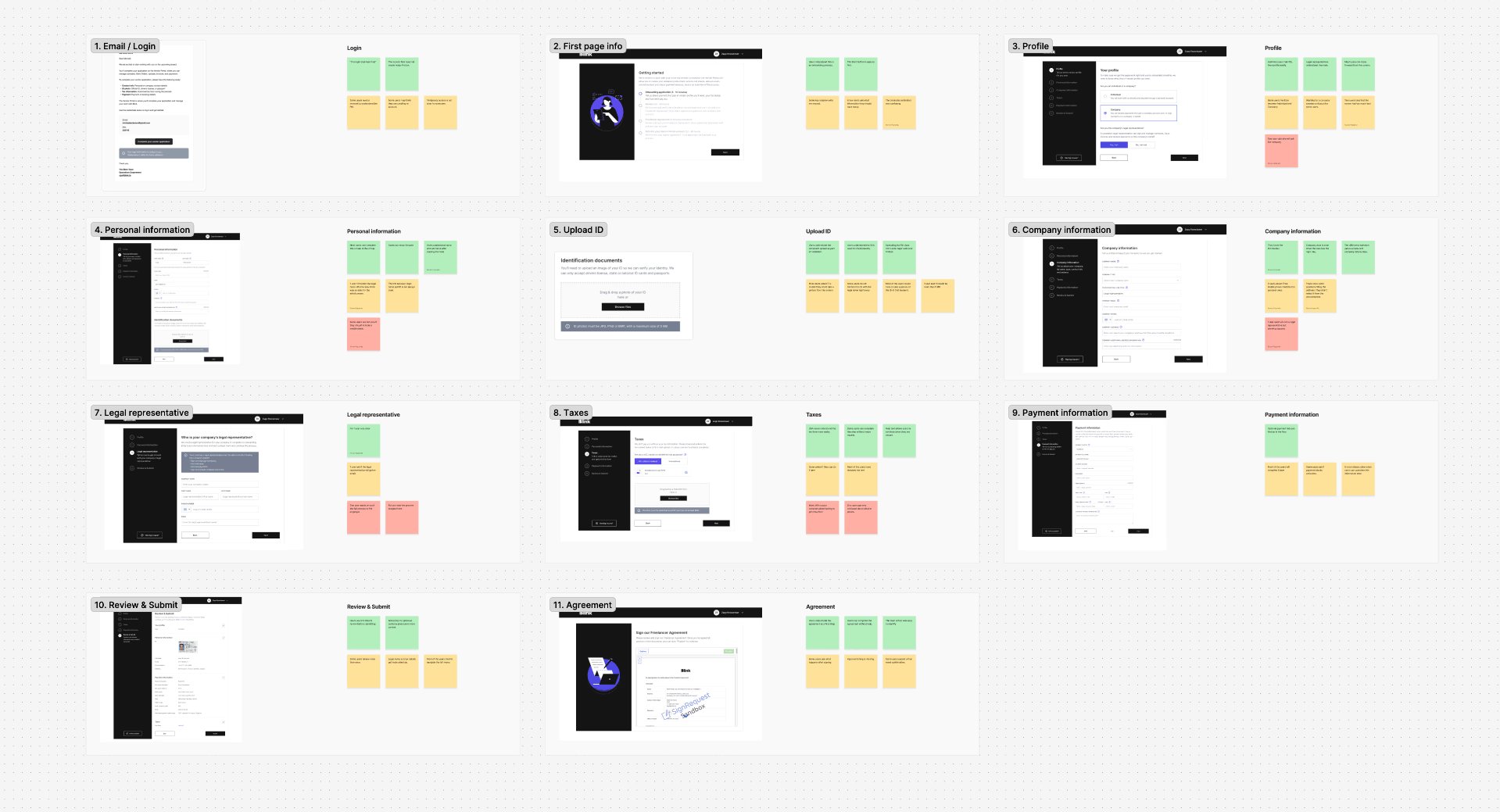
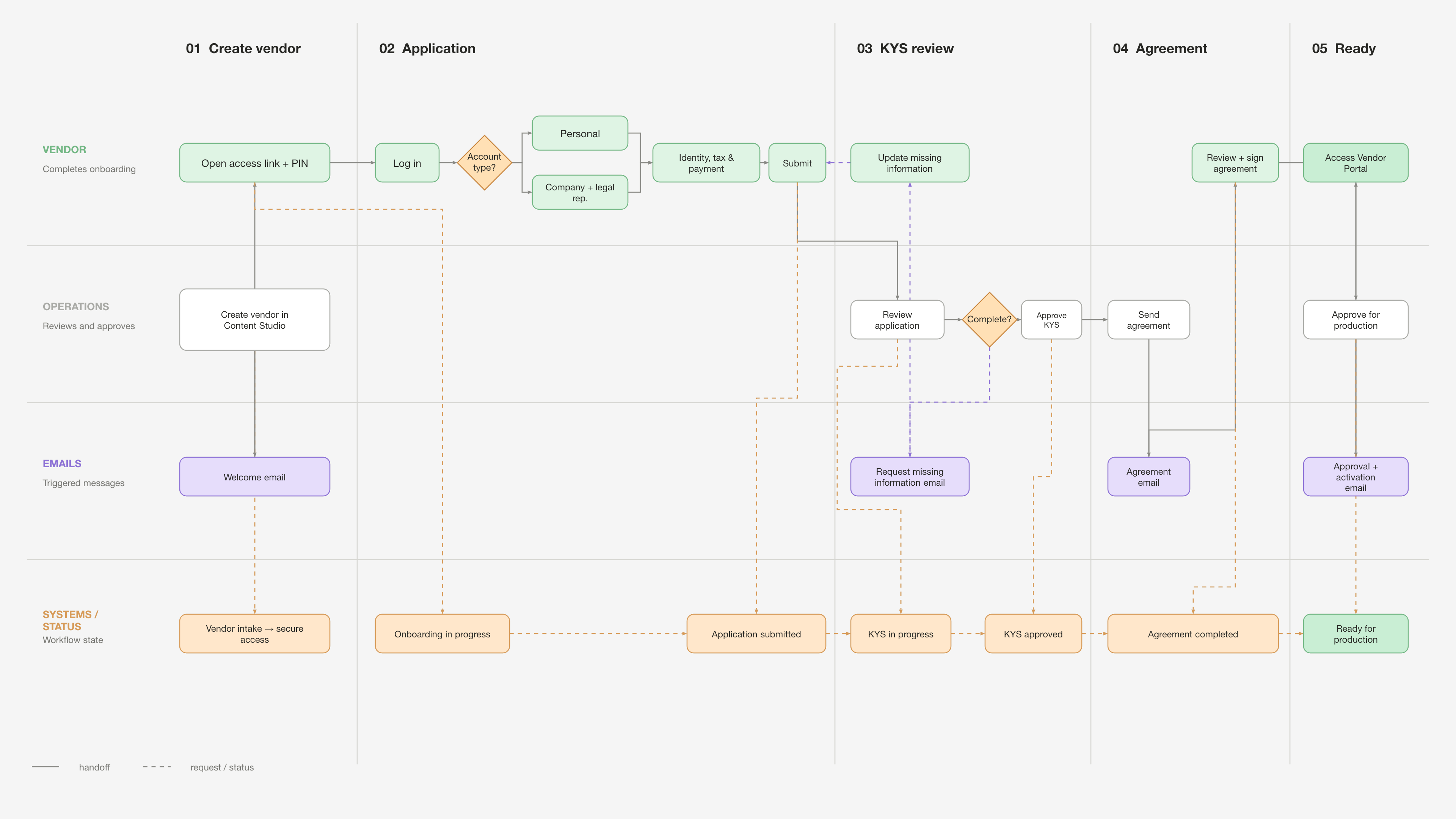
Individual or company representative.
Submit KYS to become production-ready.
Ops: access, KYS review, and activation.
Resolve gaps and activate vendors.
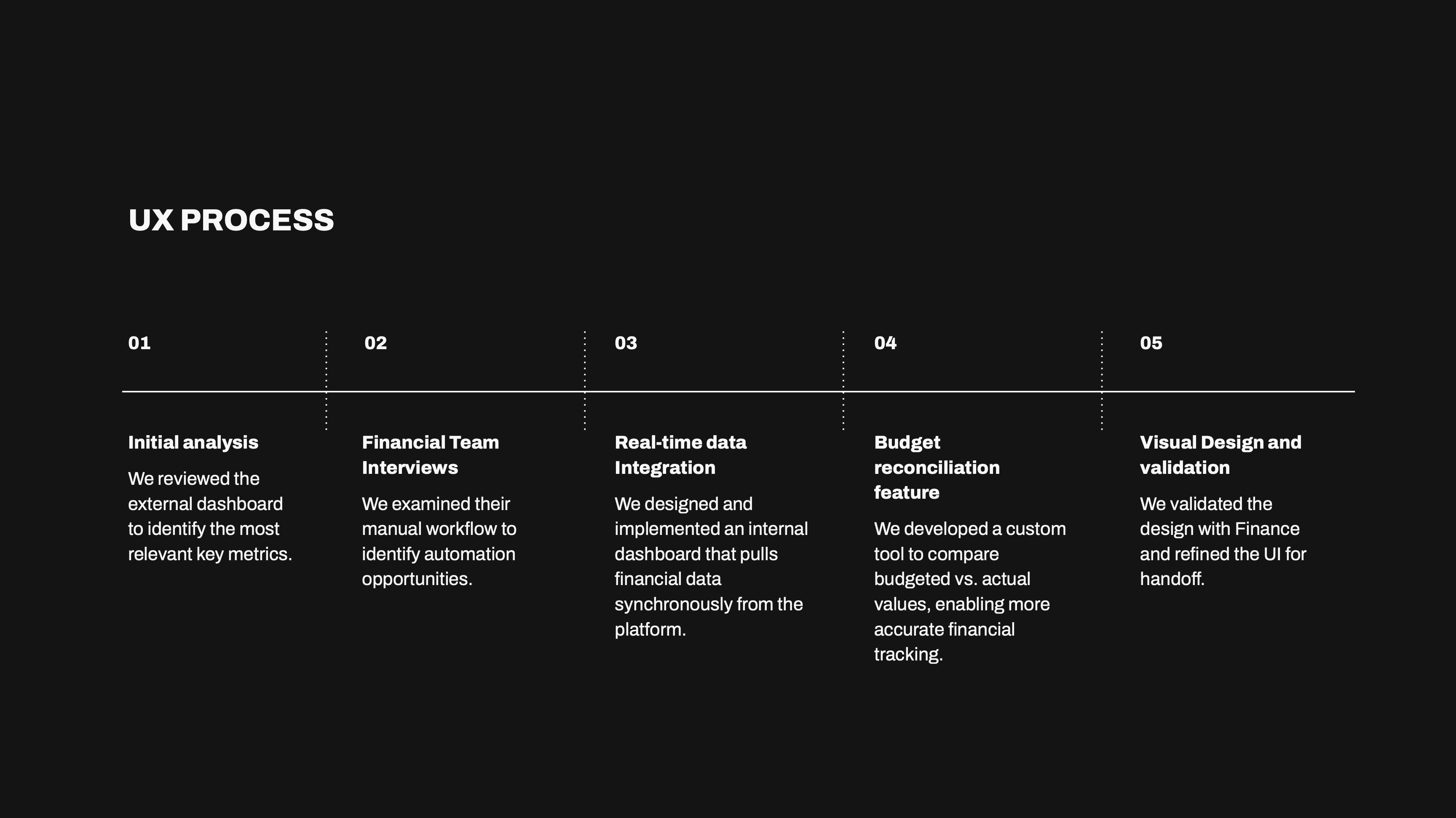
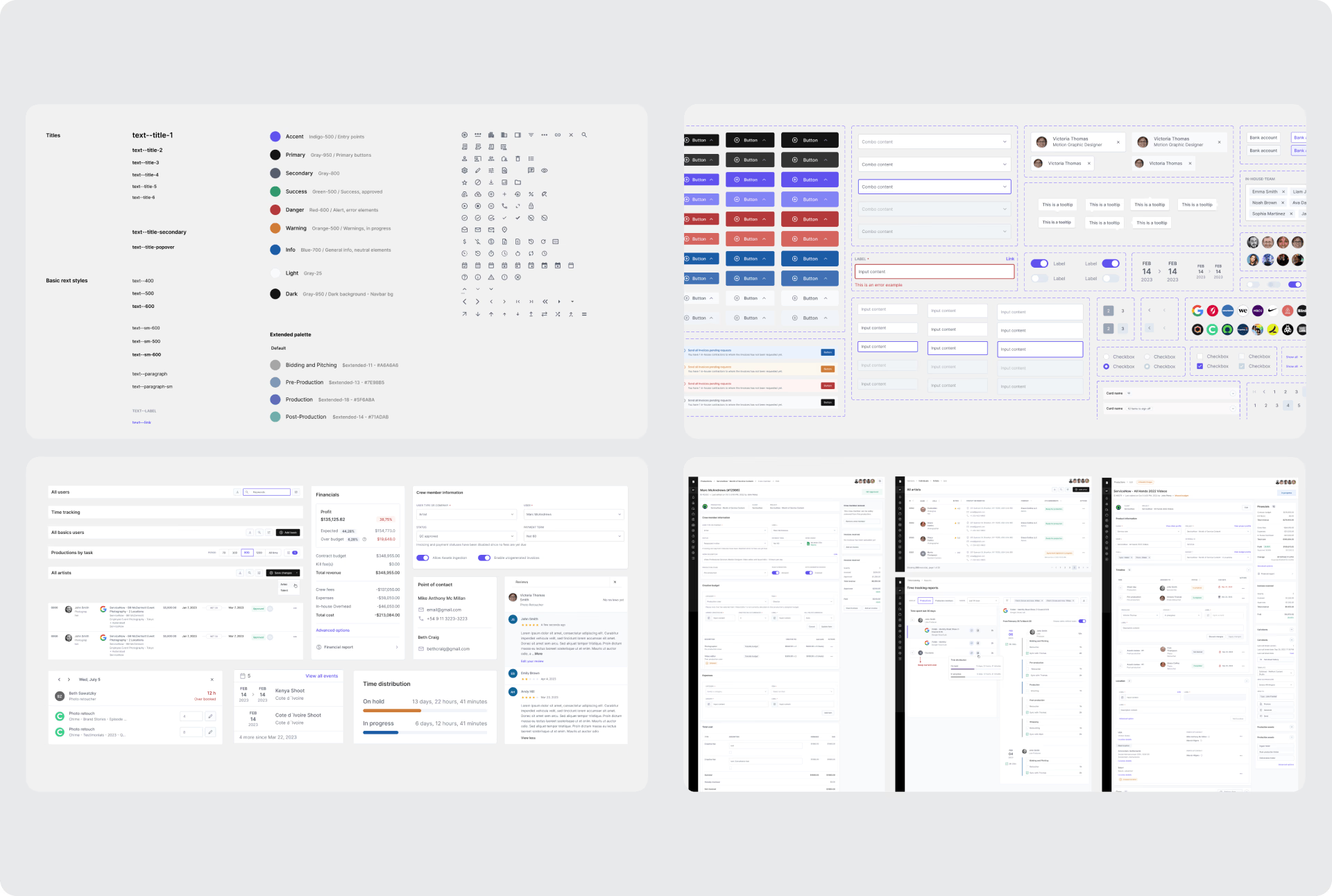
Once discovery was clear, I prioritized bringing the operation into one system. Before adding an initiative, I checked whether it reduced complexity, solved a validated pain, and helped build trust with the Production team.
That led us to add time tracking for in house teams and booking, which allowed people to reserve blocks in a future calendar. We could see whether internal capacity was enough for a production and, when it was not, decide whether to hire outside help and how that decision affected the budget.
We also added invoices generated from the fees already loaded into the system. This greatly reduced errors and the operational cost of correcting them. Anything that would not be used or would deepen fragmentation stayed out of the roadmap.
Internal back office for Production, Vendor Compliance, Finance, BD, and HR. The pain: productions, costs, and documents lived in spreadsheets, with no core the rest of the stack could connect to.
Vendor invoices showed up in the numbers, but the in-house effort behind each production did not. Time tracking made internal hours part of the same operating record, creating a credible base for discussing cost, margin, and pricing.
Hours, budget, and profitability were being reconciled after a production had already closed. The dashboard put those signals together while work was still in motion, so Operations could identify a deviation before it became a retrospective spreadsheet exercise.
Future assignments lived in spreadsheets outside the production record, so capacity planning had no connection to actual time or cost. Booking brought upcoming commitments into the suite without trying to replace every planning habit at once.
Compliance and hiring were moving through email, which made missing information, approvals, and readiness hard to see at a glance. We turned onboarding into a guided vendor flow with an operational review state, so the team could act from one source of truth.
Monthly invoice collection was a sequence of one-off requests and corrections between HR, Finance, and vendors. Batches gave that recurring work a shared status and repeatable cycle, making exceptions visible without redesigning the underlying finance process.
Card spend was reconciled elsewhere, so a production budget could look healthy while related expenses remained outside the picture. Connecting Brex expenses to productions made spend review part of the same financial context rather than another export to reconcile later.
The most important result was not shipping more features. It was changing how we built the product. At first, we prioritized functionality without a discovery process to understand how teams worked, what blocked them, and what they needed the system to solve. We spent time, effort, and money on features that nobody used afterward.
When I moved into the PM role, the focus changed. Production resisted using the platform because it did not see enough value in it, so we started building with adoption first. Every initiative had to start from a real friction and explain its business impact: helping people make data driven decisions, reducing manual work, or helping the team operate better.
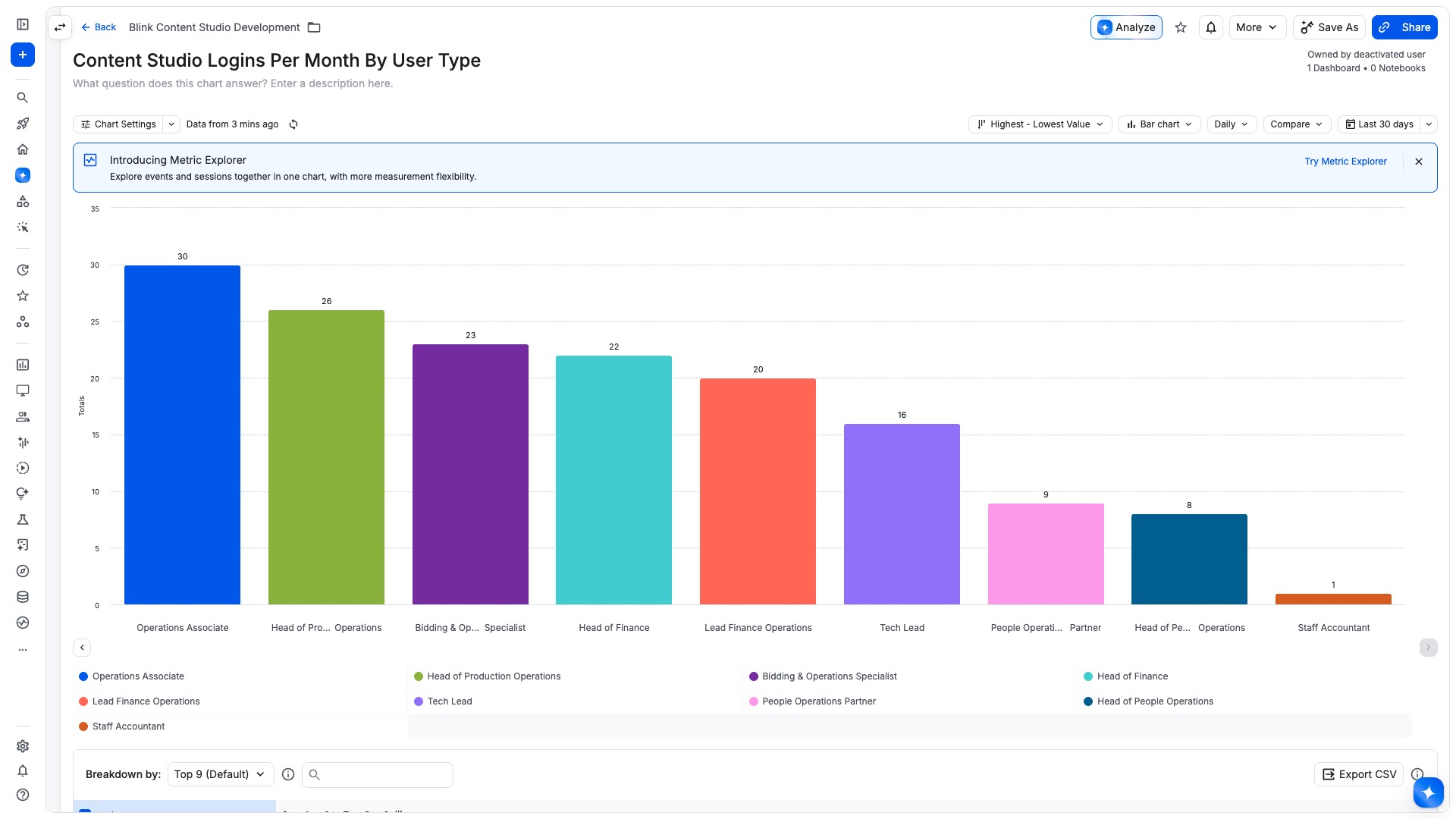
From there, Content Studio combined BI tools for data driven decisions with automations and integrations that saved time and operating cost. We stopped measuring the product by how much we delivered and started measuring how much it was used, which decisions it improved, and which manual work it avoided. The data that follows shows the reach of that operation and how it was adopted across teams.
Versión original
Productions completed end-to-end
4,503
in the Content Studio flow
Business intelligence
Gross margin
Of every $100 budgeted, $52.30 remained after real costs.
Time efficiency
Of every 100 days sold in the budget, 89 were worked.
Cost breakdown
Vendors
58%
In-house
25%
Travel, equipment rental & card spend
17%
Reconciliations based on the platform automations and integrations
Ops automation
Flows without manual intervention
0%
Invoice requests to vendors and contractors
0%
Vendor emails for legal onboarding and document signing
0%
Sales interaction in Marketplace productions
0%
In-house fee approvals — already integrated in the platform
0%
Invoice approvals to pay
0%
Signature reminders
Integrations and templates that automated the workflow
 SignRequest
 QuickBooks
 Brex card spend
 BambooHR
 Slack + in-app alerts
 Google Drive
Five operating teams, the volume they handled, and the scale enabled by the platform.
3 users
23,950
Documents processed
INV
EXP
TAX
3 users
17,362
Agreements signed
WO
FA
TR
4,633
Approved through Vendor Portal
60
Marketplace users onboarded

4 users
957
Agreements signed
SOW
MSA
1,077
Budgets created
223
Clients onboarded
555
Marketplace productions · no Sales interaction
2 users
977
Agreements signed
CA
NDA
47
Blink in-house members onboarded

36
Google in-house members onboarded

21 users
Media assets
1.1M
assets through DAM
Working on Content Studio for so many years and moving from UI Developer to Product Designer and then PM taught me to see the product from different places. As a UI Developer, I made sure the components needed by the system were there. As a Product Designer, I reported to roles that prioritized shipping features over discovery. I also understood that the system had been built before the teams who would operate it were established. They later arrived with their own tools, contexts, and deadlines, and the platform did not always fit their work.
As a PM, moving from prioritizing output to thinking about outcomes changed the team's dynamic. We stopped building from isolated requests and focused on continuous discovery, with weekly interviews across the operational teams. Shipping features was no longer enough: we had to understand the friction, connect each initiative to business impact, and measure whether people actually adopted it. I learned that an operational platform creates value when the teams who need to use it adopt it, face less friction, and operate better because of it.