Internal Creative Automation Platform

MKR

Internal platform for automating high volume display and paid social campaigns. From an HTML/CSS + GSAP template and a CSV with the assets, it generated variants and exported them as HTML, MP4, and JPG for each channel, without rebuilding every piece manually.

Roles
Head of Product
Timeline
2024–2026

The Challenge

Producing display and paid social campaigns at scale meant multiplying the same work: more variants, formats, and markets meant more production hours, more people, and more QA rounds. At the beginning of 2024, the founders asked me to focus 100% of the product team's effort on building a proprietary creative automation tool as part of a possible acquisition of a Performance Marketing company.

The request was for an in house tool that could automate display and paid social campaigns so the agency could offer a more scalable creative production service. At the same time, we had to review the tools available in the market and understand what was worth building, buying, or integrating. We had no previous experience in the display ad industry or specialized roles, so we had to learn the domain from scratch while covering the full production cycle.

My role onthe product team

Timeline

2024–2026

Job title

Head of Product

Job description

Owned strategy, discovery, prioritization, and delivery. Four roles reported to me. Set the perimeter for the in-house tool and approved design and engineering before each release.

CEO
My roleHead of Product
Tech Lead
Sr. FullStack Developer
Semi-Sr. FullStack Developer
Product Designer

Discovery Process

Discovery focused on understanding how to produce high volume display ad campaigns with the team's structure and each channel's constraints. We evaluated and benchmarked different tools to decide what we could build in house and which alternatives could cover the campaigns that MKR did not yet support.

The initial request was tied to Lottie. After evaluating its player against campaign needs, we found that some effects could not be reproduced and that the behavior was complex, unstable, and difficult to scale for the file sizes and channels we needed. That led us to pivot to HTML, CSS, and GSAP, which gave us more control and stability for that type of campaign.

There were also no creative roles dedicated to using the tool. Because it was a new internal system, adding freelancers meant training them from scratch, which made it harder to validate the flow while solving real campaigns. The product team therefore had to absorb creative pilots to demonstrate the platform's capabilities and potential.

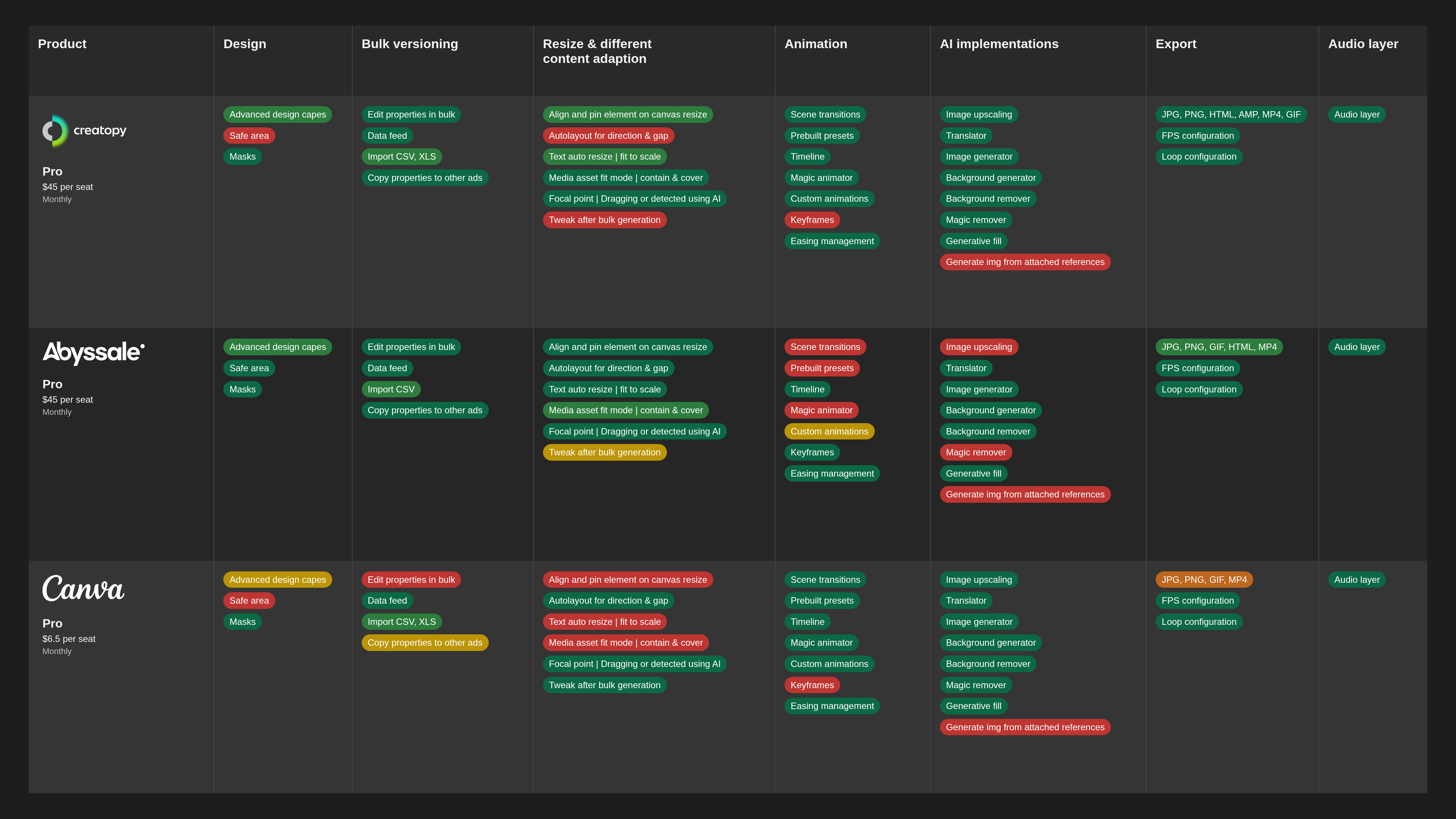
Competitive analysis of creative automation tools and the standards MKR had to meet.
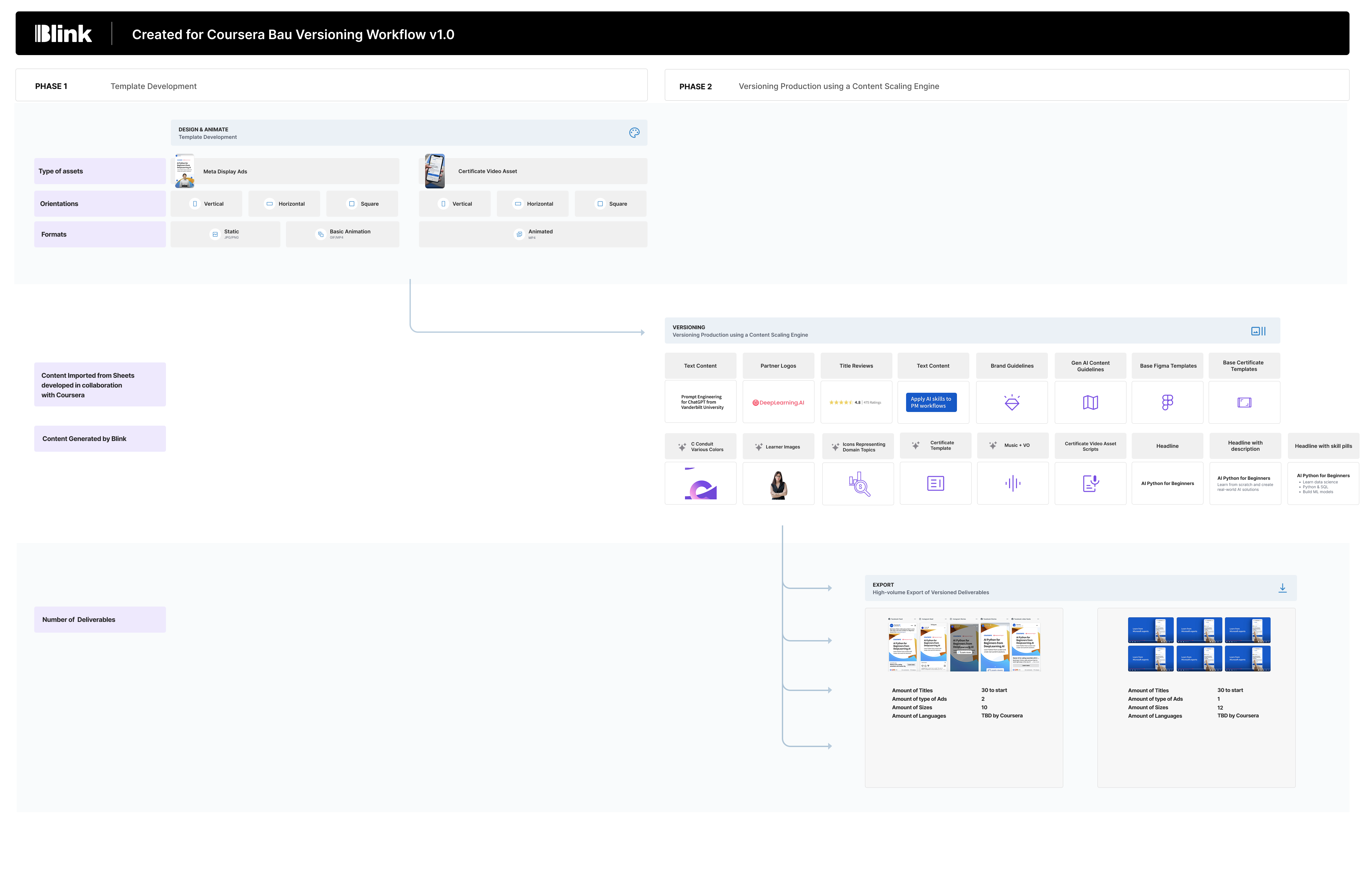
Coursera versioning workflow used to understand the content structure, variants, and deliverables the platform had to support.
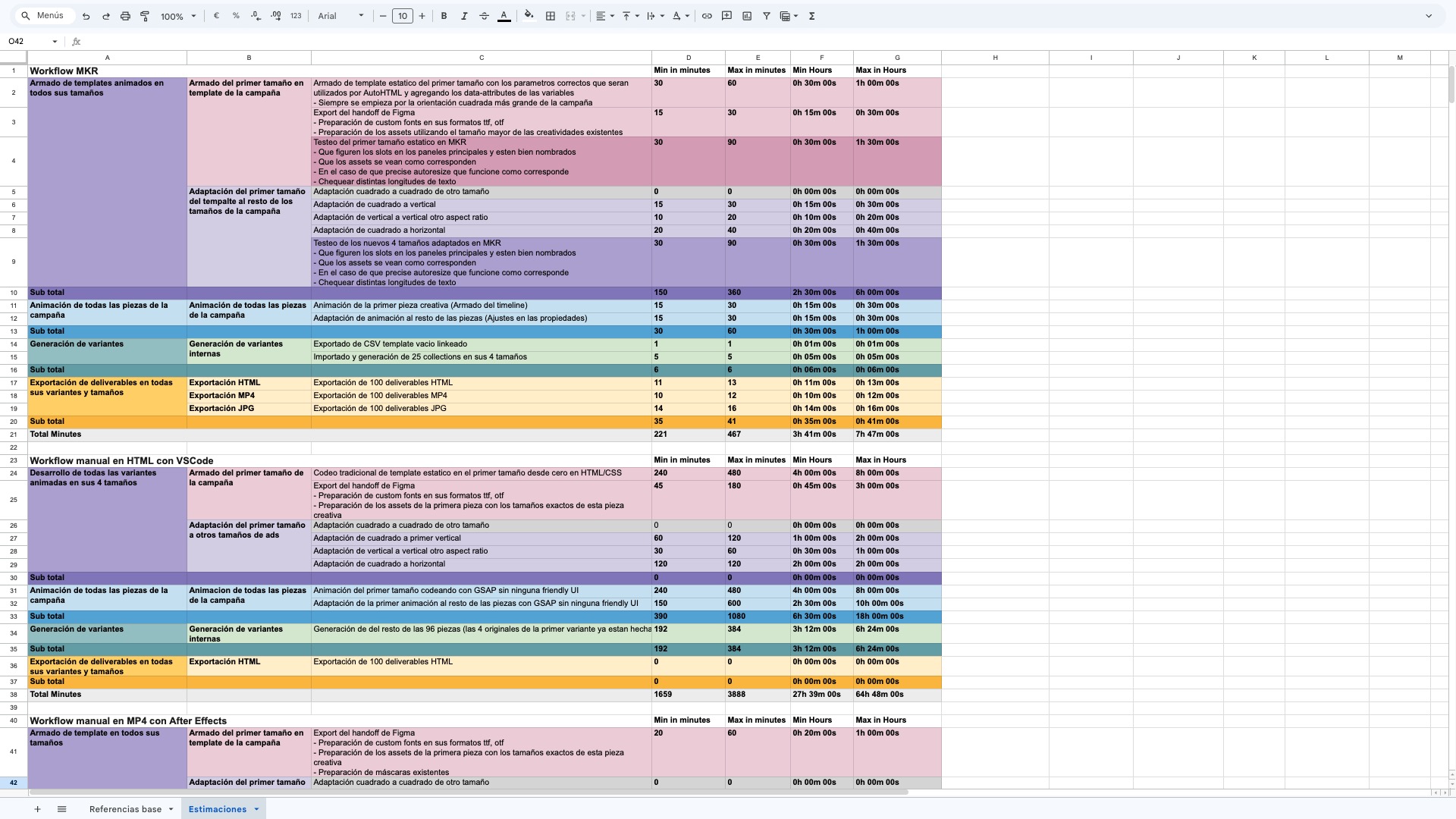
Manual production estimates used to quantify the time spent across template setup, animation, variants, and export.
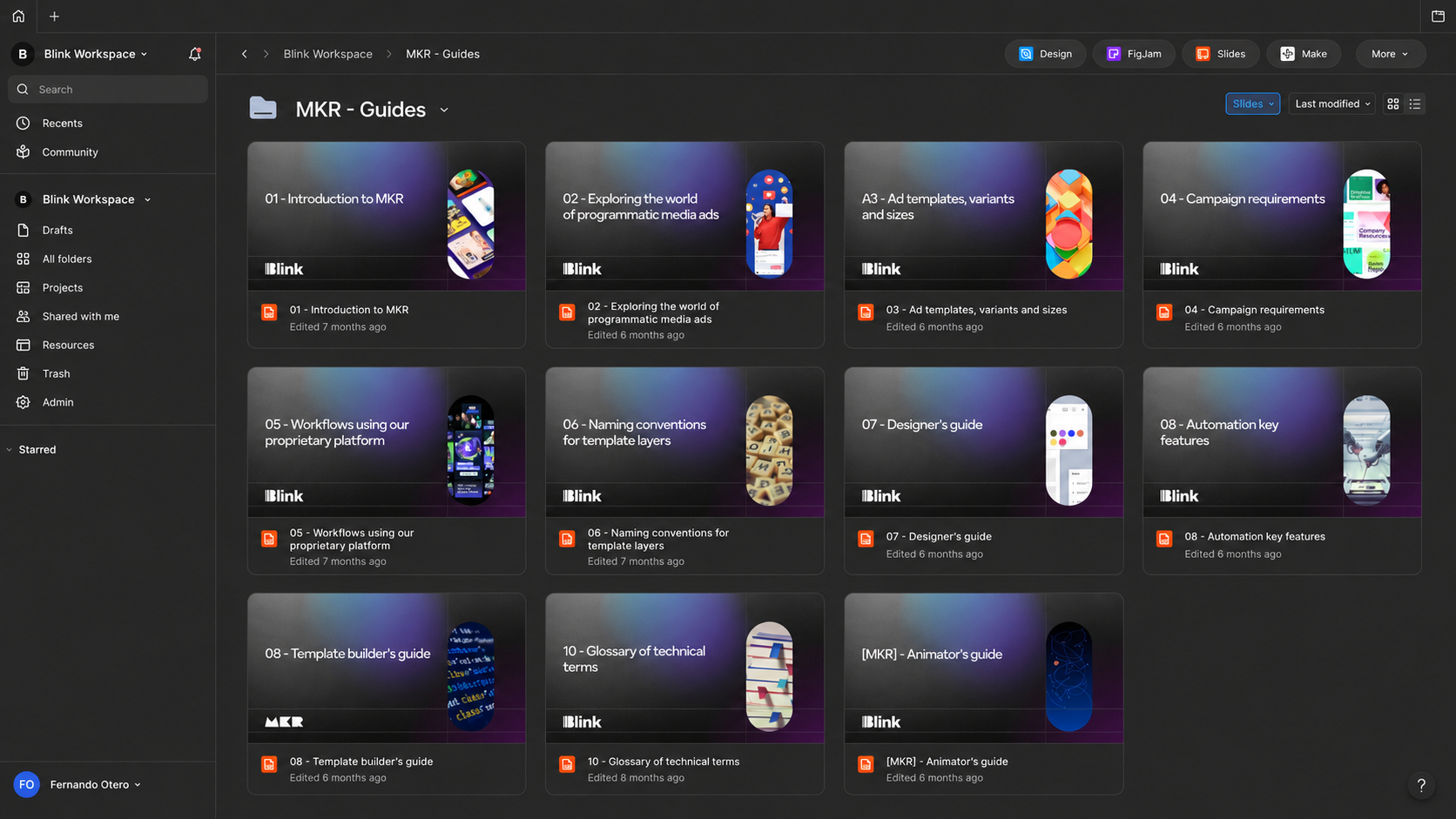
Guide materials used to document the platform workflow and help users create and adapt assets.
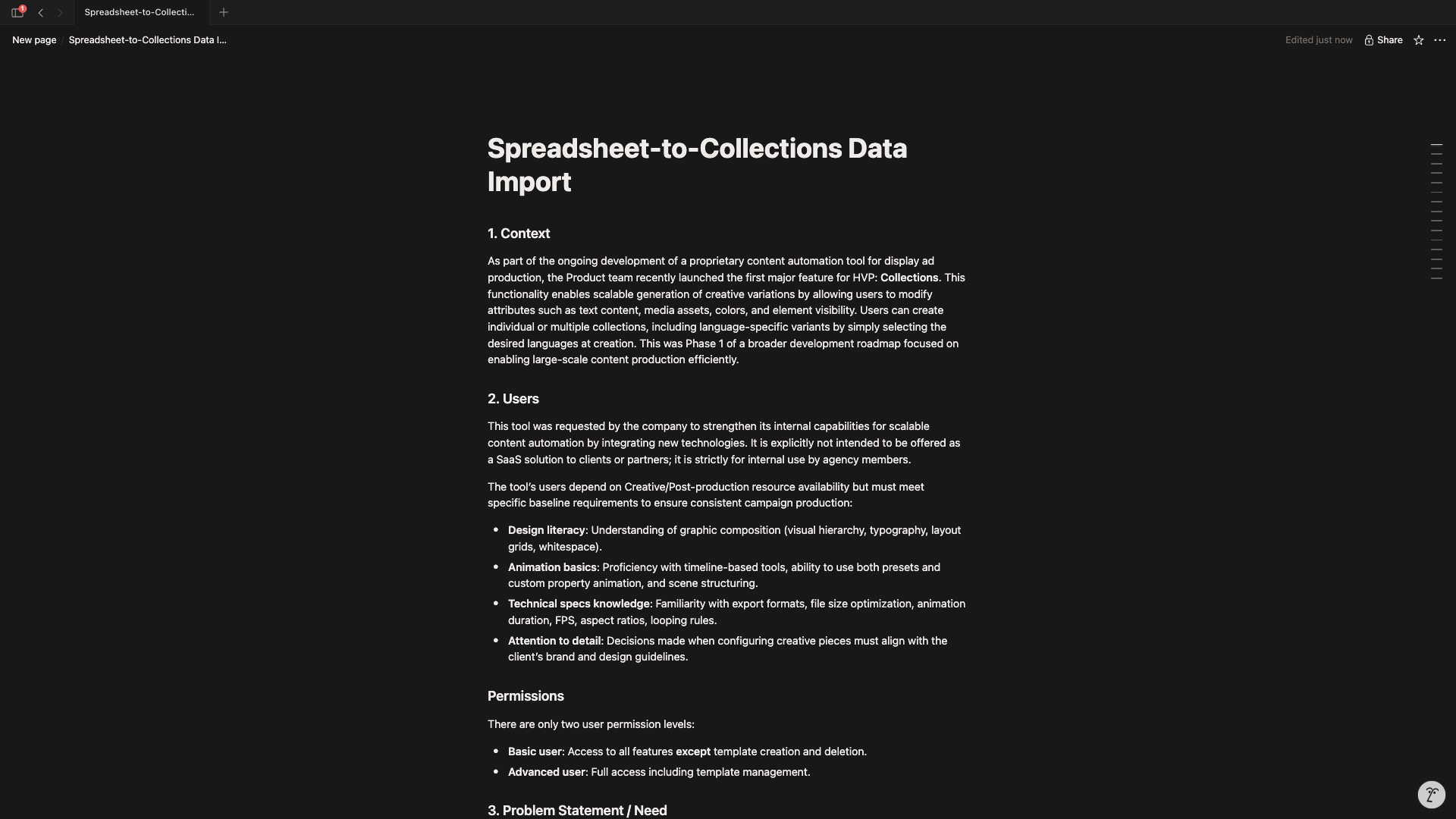
Product requirements documentation used to define scope, constraints, and release criteria.
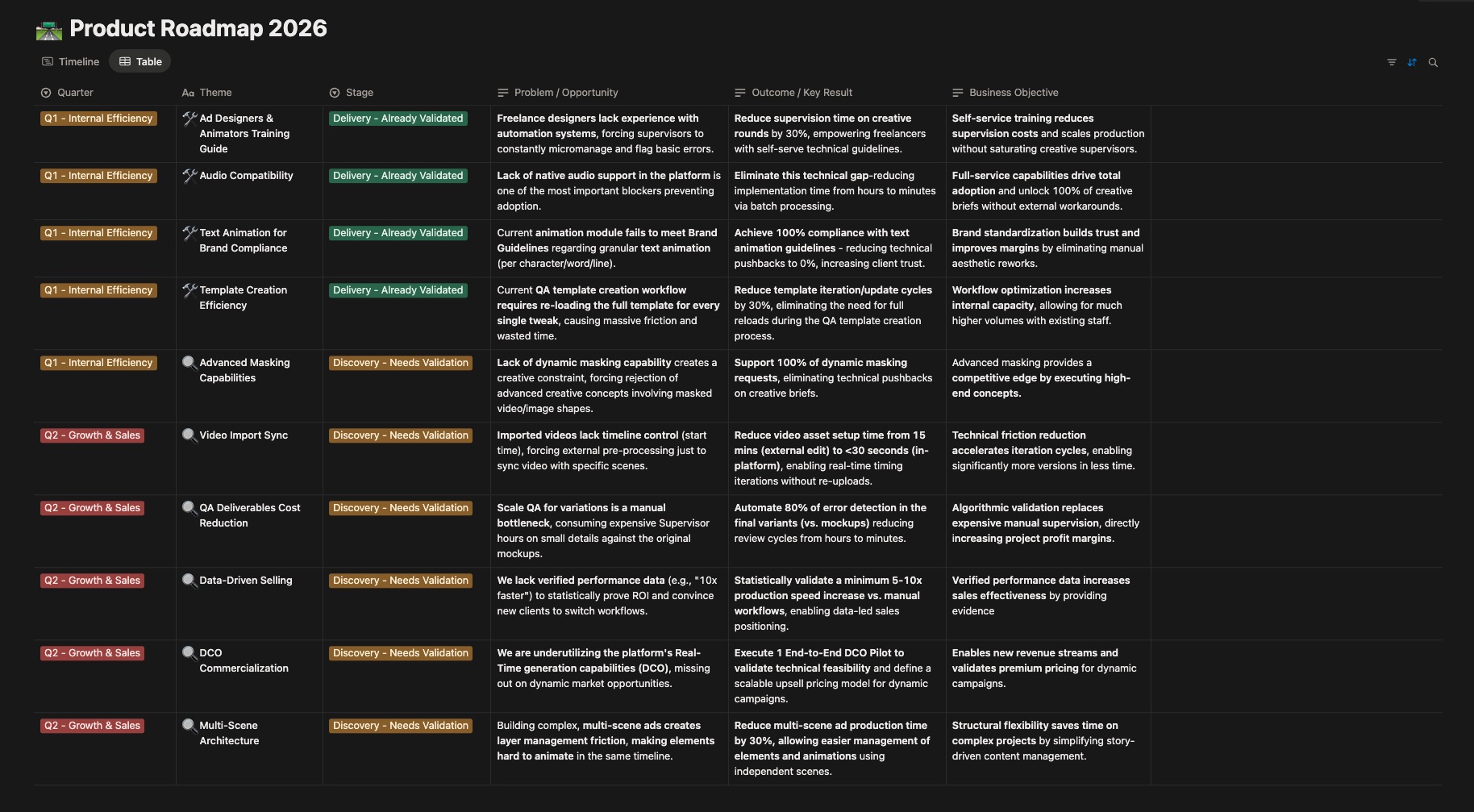
Product roadmap used to connect validated delivery work, open discovery questions, and business outcomes.
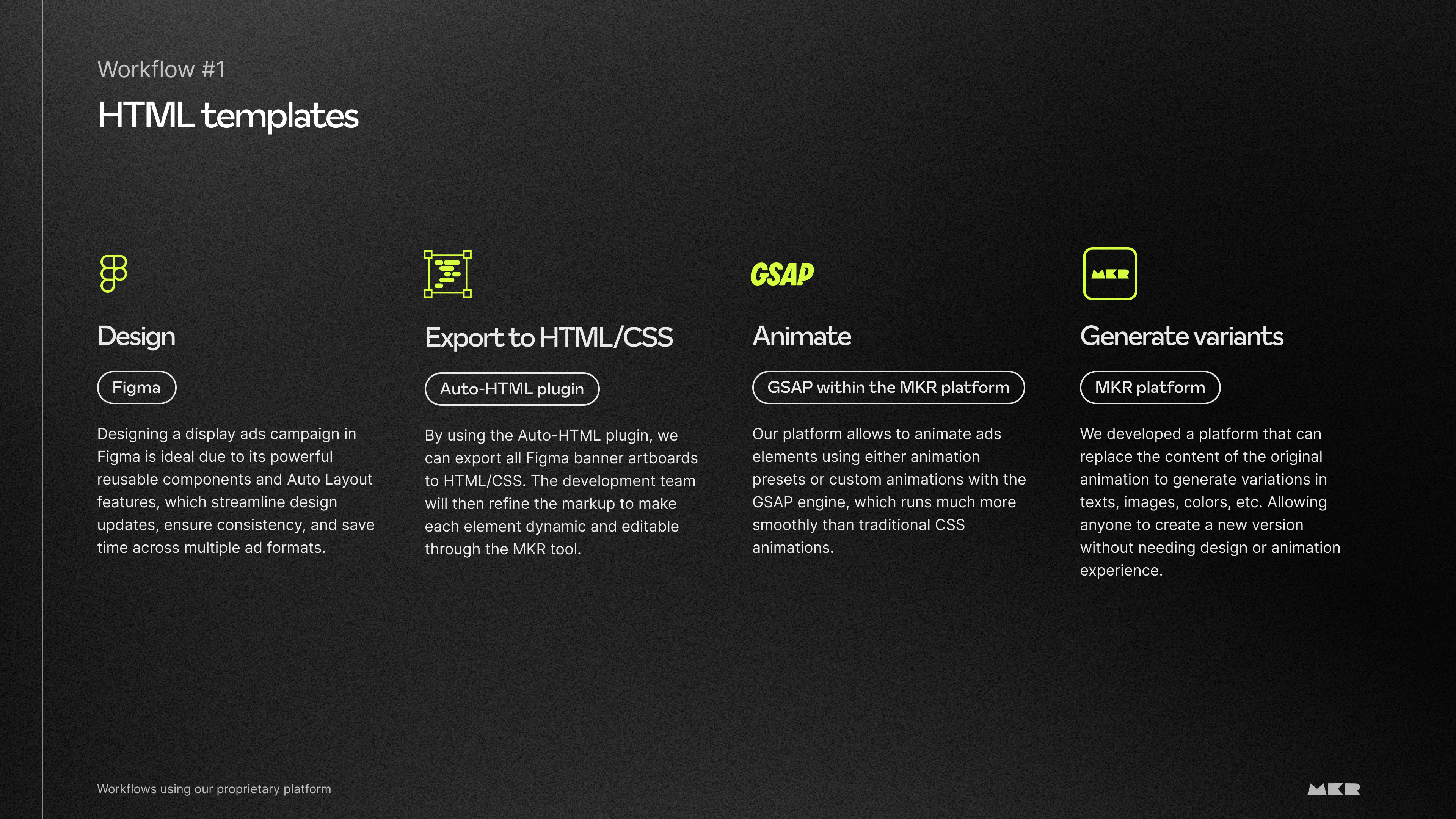
Workflow #1 showing how Figma, HTML/CSS, GSAP, and the MKR platform fit together to generate variants.

Prioritized Solutions

The focus was to build the workflow from a minimum core and expand it according to campaign needs. We first added Bulk Edit, ad sizes within one canvas, focus points for adapting multimedia content, localization with AI, and HTML, MP4, and JPG exports for each channel.

As more complex campaigns appeared, we added CSV import to scale variants in high volume productions. Animation also evolved in stages: it started with simple options, then added presets, and finally advanced controls such as delays, durations, rotation origins, and easings.

The build versus buy decision depended on the campaign type. After evaluating different tools, we recommended Cavalry for advanced motion graphics, even though it did not export HTML, and focused MKR on HTML based display campaigns. Since the industry and technology were new to the agency, we created guides and ran several trainings with different teams to explain the resources, requirements, and connections between workflows.
Templates and Bulk Edit

High-volume campaigns started from the same structure but still required manual work across every variant. Templates exposed the repeatable parts as editable slots, and Bulk Edit applied a change once without taking control away from the people building the creative.

Autoresize

New placements often meant rebuilding a composition from scratch, even when the creative idea had not changed. We defined three orientation systems and layout rules first, so additional sizes inherited a controlled adaptation instead of becoming separate files.

Animation in the UI

Motion was valuable to the final asset but remained dependent on code-level intervention. The UI translated the useful parts of GSAP into presets, a timeline, and per-element controls, keeping the workflow approachable while preserving enough control for real creative work.

Variant import and localization

Copy changes and localized versions multiplied the same production work across markets. Treating each Sheet or CSV row as a variant made the input auditable, while AI localization accelerated the language pass without hiding which version was being generated.

Export by channel

A reusable creative workflow only mattered if delivery still met each platform and client convention. Export turned the approved source into platform-ready HTML5 and media formats, with naming rules included so the final handoff did not reintroduce manual production work.

Templates and Bulk Edit

High-volume campaigns started from the same structure but still required manual work across every variant. Templates exposed the repeatable parts as editable slots, and Bulk Edit applied a change once without taking control away from the people building the creative.

Autoresize

New placements often meant rebuilding a composition from scratch, even when the creative idea had not changed. We defined three orientation systems and layout rules first, so additional sizes inherited a controlled adaptation instead of becoming separate files.

Animation in the UI

Motion was valuable to the final asset but remained dependent on code-level intervention. The UI translated the useful parts of GSAP into presets, a timeline, and per-element controls, keeping the workflow approachable while preserving enough control for real creative work.

Variant import and localization

Copy changes and localized versions multiplied the same production work across markets. Treating each Sheet or CSV row as a variant made the input auditable, while AI localization accelerated the language pass without hiding which version was being generated.

Export by channel

A reusable creative workflow only mattered if delivery still met each platform and client convention. Export turned the approved source into platform-ready HTML5 and media formats, with naming rules included so the final handoff did not reintroduce manual production work.

Outcomes

The operational impact was concrete. In the Coursera campaign, the MKR workflow was estimated to be 10.6 times faster than the manual workflow. The platform also gave the agency a new capability: producing high volume display campaigns through a repeatable workflow and adapting one production to different sizes, languages, and formats.

Not every channel or campaign needed the same technology. MKR focused on HTML based display campaigns, while Cavalry covered advanced motion graphics according to the formats, specs, and complexity of the animation. Since the industry and technology were new to the agency, we created guides and trainings for production and sales to explain the terminology, specifications, and operation of high volume campaigns with variants.

Technical impact did not automatically become business ROI. The agency had traditionally focused on video, and its usual clients did not invest in display channels, so there was no demand for this type of service. Operating an internal tool also required training freelancers, so time saved in production did not always become operational savings. The project validated delivery capability, but not repeatable commercial demand.

Coursera BAU · reference campaign

Hours recovered

0.0h

vs selected workflow

faster

0.0×

delivery speed

Estimated resource savings

USD0

recovered labor capacity

MKR7.4h0.45 min/deliverable
HTML + MP4 + JPG77.8h4.7 min/deliverable

1

Template

984

Deliverables

328 JPG · 328 HTML · 328 MP4

7.4h

Total MKR production

Ad sizes
1:1
9:16
4:5
16:9

82

Variants

Export formats

JPGMP4HTML

Learnings

When leadership asked us to develop a proprietary Creative Automation tool, I prepared a report to organize the technical and business risks of moving forward without validating demand first. I proposed cross functional teams to evaluate existing tools, learn their limits and potential, and understand the industry before investing in a tool from scratch. The decision to build was a top down bet connected to a possible agency acquisition and expansion into a new business vertical, with the goal of strengthening the agency's technology position as a differentiator.

The process made it clear that technical capabilities are not enough. We also needed demand, a clear go to market, and operational capacity. The agency's clients were more focused on traditional video, and more technical animation work was usually handled by external collaborators. In that context, training freelancers on an internal tool could absorb some of the time automation saved. My learning was to make those trade offs visible, propose ways to validate them, and support the strategic direction the company chose.